Heroes of the Borderlands Review: The New 2025 D&D Starter Set
A review of the 2025 Heroes of the Borderlands starter set — maps, cards, tokens, and a whole lot of cardboard theatre.
(In a smoky tavern somewhere on the Borderlands, a hooded figure opens a heavy box with a flourish. You, dear reader, are spared the whiff of damp parchment, but you will receive this review in the only proper voice — that of a wizard with snark, one foot in several dimensions, and an unhealthy fondness for cardboard rectangles.)
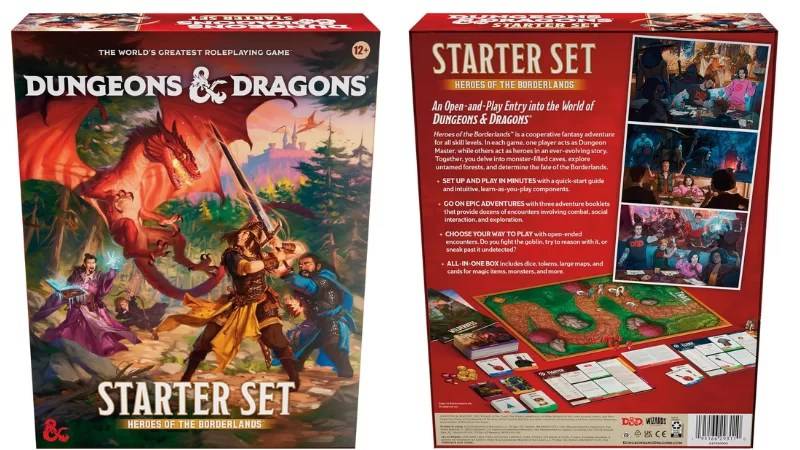
What’s Inside the Heroes of the Borderlands Starter Set?
The moment you clap eyes on Heroes of the Borderlands, you realise this starter set is not shy. It is forthright. It is grand. It says: “I bring maps. I bring tokens. I bring cards. Prepare thy table.”
Unlike the lean 2019 Starter Set or 2022’s Dragons of Stormwreck Isle, this box doesn’t whisper “training wheels.” It bellows “full production.”
Inside you’ll find:
Three modular adventures you can play in any order: a wilderness trek, a fortress under siege, and a cavern crawl.
Pre-generated character boards with simplified rules and abilities front-loaded for easy reference.
Two large double-sided poster maps — colourful, sturdy, and immediately useful.
Punch-out tokens for monsters, treasures, terrain, and conditions, all crisply illustrated.
Reference sheets and a DM combat tracker to speed up encounters.
A full set of dice (with extra d6s and d20s, since those are always the ones you need for fireball madness and a the inevitable stealth disadvantage).
A veritable horde of cards for spells, monsters, NPCs, conditions, items, and equipment.
This isn’t just a starter kit. It’s an entire tabletop theatre troupe in a box, with maps as stage, tokens as actors, and cards as props.
A Closer Look at the Components
The Adventures
The three adventures are deliberately modular. You can run them in order, mix them around, or steal bits for your own campaign. Each adventure offers a different flavour — from wilderness exploration to fortress intrigue to claustrophobic dungeon crawl.
The writing aims at accessibility: new DMs will find plenty of guidance, while veterans will spot opportunities to embellish. Replayability is much stronger than in previous starter sets, thanks to the non-linear approach.
The Character Boards
Pre-generated heroes are an underrated tool. They let new players jump straight into action without wrestling the full Player’s Handbook. The boards print stats, abilities, and basic rules directly on the sheet.
That said, they’re not flawless. Some players reported confusion over layout — DCs and attack rolls weren’t always clear, and flipping sides could interrupt flow. They’re visually attractive, but could have leaned harder into function over form. And I personally found the lack of straight ability scores, in favour of just displaying modifiers, a refreshing change to make it less confusing for new players (until you ask them to use their strength score for something and then who knows what will happen).
The Maps
Two double-sided poster maps add instant drama. Whether your group favours tactical positioning or simply likes pretty visuals, these maps elevate play. They’re sturdier and more versatile than anything in older starter sets.
For new DMs, they reduce the pressure of running “theatre of the mind.” For experienced groups, they double as reusable battlemaps for homebrew adventures.
The Tokens
Punch-out cardboard tokens cover monsters, treasures, traps, terrain, and even conditions. Instead of vague whiteboard sketches, you can drop a cardboard orc right on the map. Treasure becomes tangible.
The tokens are sturdy, plentiful, and endlessly reusable. You’ll likely keep reaching for them long after the included adventures are over.
The Dice
Generous is the word. A full set plus extras where you need them most (multiple d6s, an extra d20). They’re basic in design, but solid and useful. For new players, it means you can run a table without asking everyone to bring dice.
The Cards
The star of the show. Every major element of play is translated into cards: spells, NPCs, equipment, monsters, and conditions. Instead of scribbled notes or constant rulebook flipping, you just hand over the relevant card.
Need to cast Magic Missile? Play the spell card.
Fighting goblins? Pull the goblin monster card.
Poisoned? Place the condition card next to your hero board.
It makes the game more tactile and intuitive, though also a little more board-game-like. Some purists may sneer. Many newcomers will cheer.
Strengths of Heroes of the Borderlands
Accessibility – Streamlined species and class options, visual aids, and tactile components lower the barrier to entry for newcomers.
Card-Driven Clarity – Everything important is on a card. No more forgetting spell ranges or conditions mid-combat.
Replayability – The modular adventures and reusable maps/tokens extend the life of the set. It’s not infinite, but it’s far better than older boxes.
Visual Appeal – Crisp art, sturdy boards, satisfying tokens, and attractive poster maps make the game feel premium and exciting right out of the box.
Value Beyond the Box – Even once the adventures are played, the cards, tokens, and maps remain useful in homebrew campaigns.
Weaknesses of Heroes of the Borderlands
The DM Still Needs to Prep – Despite all the tools, some adventure text is vague. First-time DMs may need extra time before running a session.
Character Boards Can Confuse – Attractive but not always intuitive; some stats and rolls are harder to find than they should be.
Less Flexibility for Veterans – Options are deliberately slimmed down. Great for onboarding, but frustrating for players who already know the rules inside out.
Replay Value Isn’t Infinite – The set shines for 5–10 sessions, but beyond that, you’ll want new content. Luckily, the reusable components soften this limitation.
Heroes of the Borderlands vs. Dragons of Stormwreck Isle
How does Heroes of the Borderlands stack up against 2022’s Dragons of Stormwreck Isle?
Scope: Stormwreck was a linear five-level adventure. Solid, but narrow. Borderlands sprawls across three modular stories and offers greater flexibility.
Components: Stormwreck gave you pregens, dice, and a slim rulebook. Useful, but sparse. Borderlands explodes with poster maps, tokens, trackers, and a full card system.
Accessibility: Both are beginner-friendly, but Borderlands doubles down on accessibility by translating rules into cards and conditions into tokens. It’s simply easier to grasp.
Longevity: Once you finish Stormwreck Isle, it goes back on the shelf. Borderlands, however, leaves you with reusable tools — the cards and tokens make it valuable long after the three adventures are done.
If Stormwreck Isle was dipping a toe in the water, Borderlands is cannonballing into the deep end with an armload of dice and enough tokens to wallpaper your tavern.
Final Verdict: Should You Buy Heroes of the Borderlands?
Heroes of the Borderlands isn’t flawless. It edges toward board-game territory, which will irk some purists. The character boards could be clearer. And yes, even with cards and maps, the Dungeon Master still needs to prep.
But as a gateway to Dungeons & Dragons, it’s excellent. It’s generous, tactile, visually appealing, and endlessly card-obsessed. For brand-new players, it’s perhaps the best introduction D&D has ever offered. For veteran groups, it’s a toolkit brimming with reusable pieces.
So unbox it. Lay out the maps. Shuffle the goblins. Hand over the condition cards. And may your first fight in the Borderlands be as memorable as a Discworld novel read aloud in a thunderstorm.